
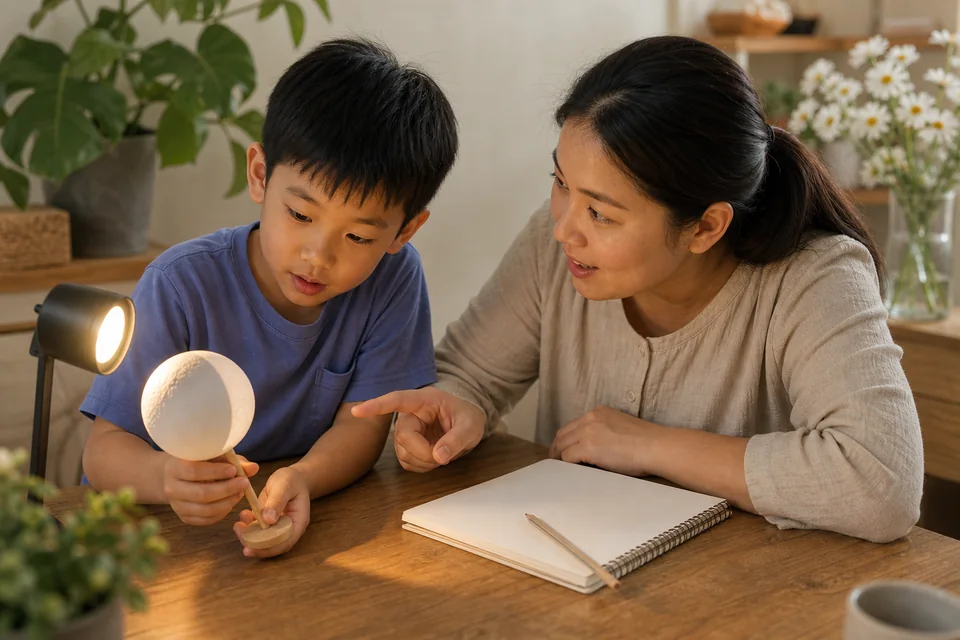
“Why does the Moon change shape?” “Why do humans not lay eggs?” Children ask an astonishing number of questions, and it is tempting to treat each one as a gap to be filled with the correct answer as quickly as possible.
But the question itself is the treasure. A child who keeps asking “why?”, “how?” and “what if?” is building the engine that drives all later learning. Our job is less to supply answers and more to keep that engine running.
Answers close doors; questions open them
A quick answer often ends the conversation. A returned question, such as “what do you think happens?”, keeps it going. When children are invited to guess, predict and test, they learn that ideas can be tried out, that being wrong is a step rather than a failure, and that they are capable of finding things out for themselves.
That belief is worth more than any single fact, because the most meaningful learning often begins with a simple thought: “What happens if I try this?”
Make ideas visible at home
You do not need a laboratory. When a question comes up, look for a way to see it: shine a torch on a ball to watch the “moon” change shape, float and sink the bath toys, plant a seed in a clear jar and check on the roots each morning.
Wonder aloud alongside your child: “I wonder why that one sank?” Resist tidying every experiment into a lesson. Noticing, guessing and looking again is the whole game.
Let them change their minds
Real thinking means revising. When your child notices something that does not fit their theory, celebrate the noticing: “you thought it would float, and then what happened?” Children who are allowed to change their minds learn to follow evidence. That is a braver skill than being right the first time.
Where Nurture Curiosity comes in
This is exactly the spirit behind Nurture Curiosity, our question-led science workshop series. A session starts with something wonderfully puzzling, and instead of rushing to a textbook answer, we make the idea visible. Children build models, investigate evidence, make and test predictions.
We want children to leave with an answer, but also with something more valuable: a sharper eye, a braver question and the feeling that the world is full of things they can investigate.


Ready to play?
Join us for a sensory play session or a workshop — we prepare everything, you bring the curiosity.
Book a session