
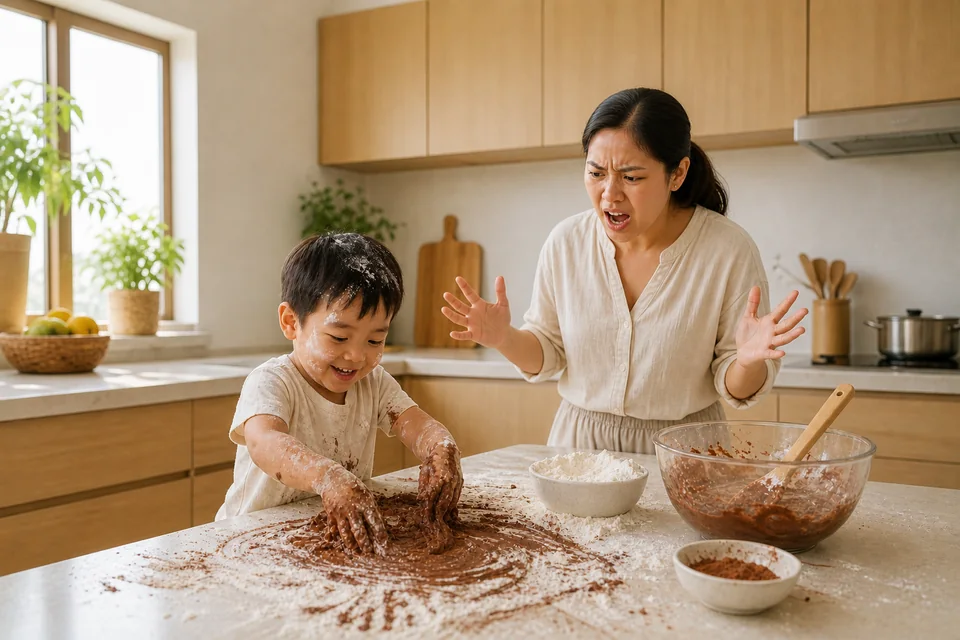
You know the moment. The rice leaves the tray, the yoghurt meets the floor, and something in your chest tightens before you have even decided how to react. If watching your child make a mess makes you genuinely uncomfortable, you are not a bad parent — you are a perfectly normal adult.
We talk a lot about why mess is good for children. This post is about the other half of the story: why it is so hard for us — because understanding the flinch is the first step to loosening its grip.
It is not really about the mop
The obvious explanation is workload: someone has to clean it up, and that someone is usually you. That is real, and it counts. But notice that the discomfort often arrives before you have done any cleanup maths, and out of all proportion to it. A few grains of rice on the floor is a ten-second sweep, yet it can feel like an emergency.
That is because mess presses on something deeper than chores: our sense of order and control. A tidy room is one corner of life that behaves. Watching it come undone, deliberately and gleefully, at the hands of a small person you are responsible for, can feel like losing your grip on the whole day.
We were once told off for this too
Most of us grew up hearing “don’t touch that”, “you’re making a mess”, “look at the state of you”. Those reactions settle in deep. When your child smears porridge across the table, the voice of alarm you hear may not entirely be your own. It can be an echo of how mess was treated when you were the small person at the table.
Simply noticing that echo is powerful. It turns an automatic reaction into a choice: you get to decide whether to pass it on.
What the mess looks like from their side
To your child, the moment is not destruction — it is investigation. The tipping, smearing and scattering that reads as chaos to us is a young scientist running experiments: what happens when I pour from higher up? What does this feel like on my whole hand?
None of that makes the mess less real. But it changes what you are looking at: not a problem to stop, but learning wearing its work clothes.
Making peace, not surrendering
Embracing mess does not mean allowing everything, everywhere. In fact, boundaries make it far easier to relax: a designated tray or mat, one messy material at a time, clothes that are allowed to be ruined, and a cleanup routine your child helps with.
Give the mess a container, both in space and in time, and you can say a wholehearted yes inside it. “The rice stays on the sheet” is kinder on everyone than a vague, anxious “be careful”.
And when you need a day off
Some days you simply do not have it in you — and that is fine too. It is one of the reasons our sessions exist: a space where the mess is planned for, contained and cleaned up by somebody else. Your child gets to go all in; you get to watch the marvellous mess unfold and then walk away from it, chest untightened.


Ready to play?
Join us for a sensory play session or a workshop — we prepare everything, you bring the curiosity.
Book a session